Servicing the feature film industry for over 35 years
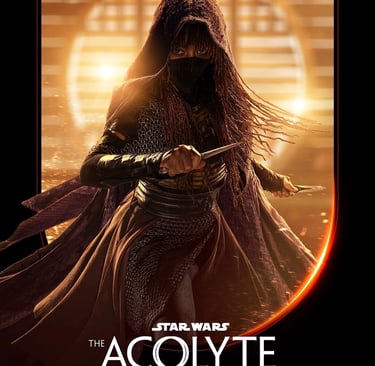
The Acolyte took me into the Star Wars world, with the production based at Shinfield Studios.
From a Special Effects point of view, it had many of the elements you would expect from a Star Wars production — motion bases, showers of sparks, squib and laser hits, along with plenty of physical interaction to help sell the action on set.
We created effects for lightsabers cutting through trees, as well as large-scale wind effects for sequences involving the Force. These were often substantial rigs in their own right, designed to move costume, foliage and debris together so that the environment reacted physically around the performers rather than relying entirely on VFX.
One of the largest sets was a huge interior jungle environment, heavily dressed with mist and atmosphere smoke. That set also led to one of my favourite solutions on the production.
The problem was that the jungle set needed to be photographed looking upwards, but above it sat all the usual stage rigging, steelwork and equipment you simply didn't want to see.
We came up with the idea of pumping hot air into the top of the stage and then introducing smoke into that warmer layer, allowing it to collect overhead rather than dropping immediately back down into the set.
The result was effectively a layer of artificial cloud sitting above the jungle.
It completely disguised the rigging and meant Camera could shoot upwards into the roof space without immediately requiring a large VFX clean-up. What had started as a practical problem ended up becoming part of the look of the environment itself.
That is probably the effect I remember most from The Acolyte. It was simple in principle, but incredibly effective — and strangely enough, something I had never done before and haven't had reason to do since.
A good example of why I still enjoy practical Special Effects: sometimes the most satisfying solution isn't the biggest mechanical rig or explosion, but finding a relatively simple physical way of solving a problem directly in camera.